Turning Losses into Wins: How One Founder Rebuilt After a Public Product Flop
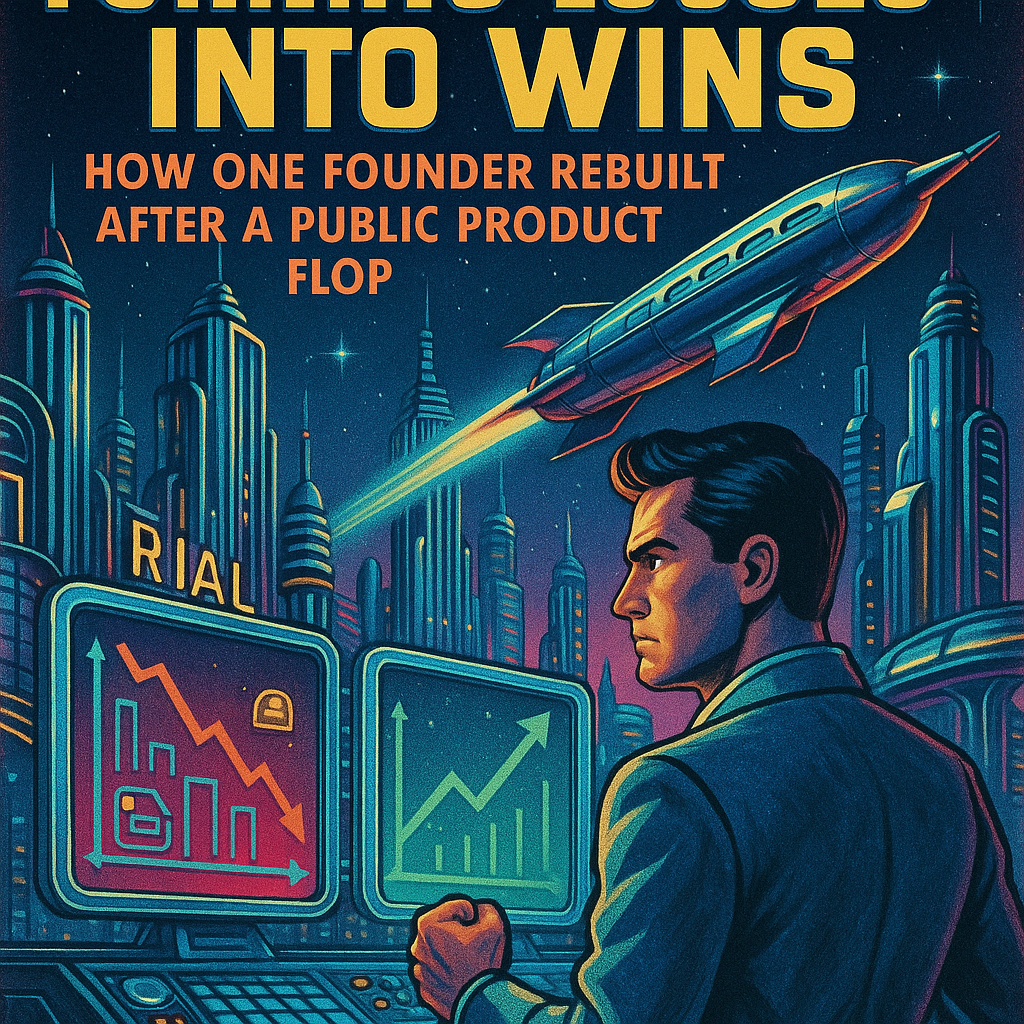
Turning Losses into Wins: How One Founder Rebuilt After a Public Product Flop
When his launch day cratered, the founder watched metrics fall in real time. The product got confused reviews, the press framed it as a miss, and the team lost momentum. He could have doubled down on explanations or quietly mothballed the project. Instead he treated the failure as data and rebuilt on different assumptions.
This article uses that real-world scenario to show how leaders and operators transform defeat into advantage. The primary lesson is simple. Turning losses into wins depends less on avoiding failure and more on how you interrogate it and act on what you learn.
Diagnose the loss the way you would diagnose a product
First, separate emotion from evidence. Failures trigger defensiveness. That response hides the signal you need.
Start with three facts. What did you expect? What actually happened? What changed between expectation and outcome? Record those facts without commentary.
Then inventory the assumptions behind your plan. Label each assumption by how critical it was to success. Which assumptions failing would cause total collapse? Which would only slow progress? That mapping tells you where to focus fixes.
Finally, collect direct feedback. Customer quotes, session recordings, sales numbers, refund reasons. Treat anecdotes as hypotheses to test, not final judgments. When you diagnose a flop this way you create a path from emotion to experiment.
Convert failures into experiments
A failure is a failed hypothesis. That reframes the moment. It moves your team from blame to curiosity.
Turn the biggest unknown into a defined experiment. If adoption was low, run a small pilot with a changed onboarding flow. If product-market fit was weak, test a different target segment with ads and outreach sized to validate quickly.
Keep experiments small and measurable. Define the metric that proves or disproves the fix. Set a time box. Decide in advance what you will do if the experiment fails. That discipline prevents sunk-cost traps and keeps the momentum of learning.
Rebuild around constrained strengths
When everything goes wrong you still have assets. The trick is to constrain the problem so those assets matter.
List available strengths: team skills, existing customers, technology you already own, distribution channels you can reach without huge spend. Then ask one question. Given these assets, what version of the product would actually win?
Often the answer is a narrower, lower-cost offering that solves a core problem for a specific subgroup. Narrowing focus does two things. It reduces the number of assumptions you must prove. It increases the value of your existing assets. That combination shortens the path from loss to initial win.
How narrowing helped in practice
The founder I referenced cut nonessential features and targeted a smaller user segment. He rebuilt the onboarding to match how that segment worked. The result was not a blockbuster. It was a stable stream of users who stayed longer and referred others. That stability allowed incremental improvements and steady growth.
Change the narrative without hiding the truth
How you tell the story of a failure matters. Silence or spin erodes trust. Honest framing restores it.
Share what you learned and what you will test next. Keep the story specific. Say what went wrong, and then describe the next experiment and metric. That communicates competence. It signals to customers and partners that you operate by evidence, not hope.
Leaders who practice this build cultures that treat loss as fuel. If you want guidance on framing difficult transitions and rebuilding credibility, study how thoughtful leaders use transparency as a tool for progress. The right approach to communication strengthens your position as you rebuild. Link to leadership thinking that helps reshape teams and narratives can be a useful reference for anyone facing a recovery phase. See this resource on leadership for practical frameworks: leadership.
Institutionalize the lessons so you do not repeat the same loss
Short-term recovery buys you time. Long-term resilience requires institutional change.
Convert each failed assumption and the experiments you ran into a simple playbook. When a similar situation appears, your team should know the steps to take. That playbook can be short. It should include how to diagnose, which metrics to check, and the decision rules for pivoting or doubling down.
Also create a lightweight postmortem ritual. Meet within a few days. Share the facts. Capture the experiments you will run. Make those notes visible to the whole company. The ritual reduces the shame around failure and increases the speed of learning.
Closing insight: loss points to leverage when you know how to read it
Failures are not destinies. They are compressed lessons. When you abandon judgment and start measuring, you convert noise into signal. When you constrain your rebuild to what you can actually change, you create early wins. When you tell the truth and document the lessons, you build a muscle that lets you recover faster next time.
Turning losses into wins does not require brilliant strategy. It requires a consistent process: diagnose, experiment, focus, communicate, and institutionalize. Use those steps and you will trade the fear of failure for a repeatable path to progress.