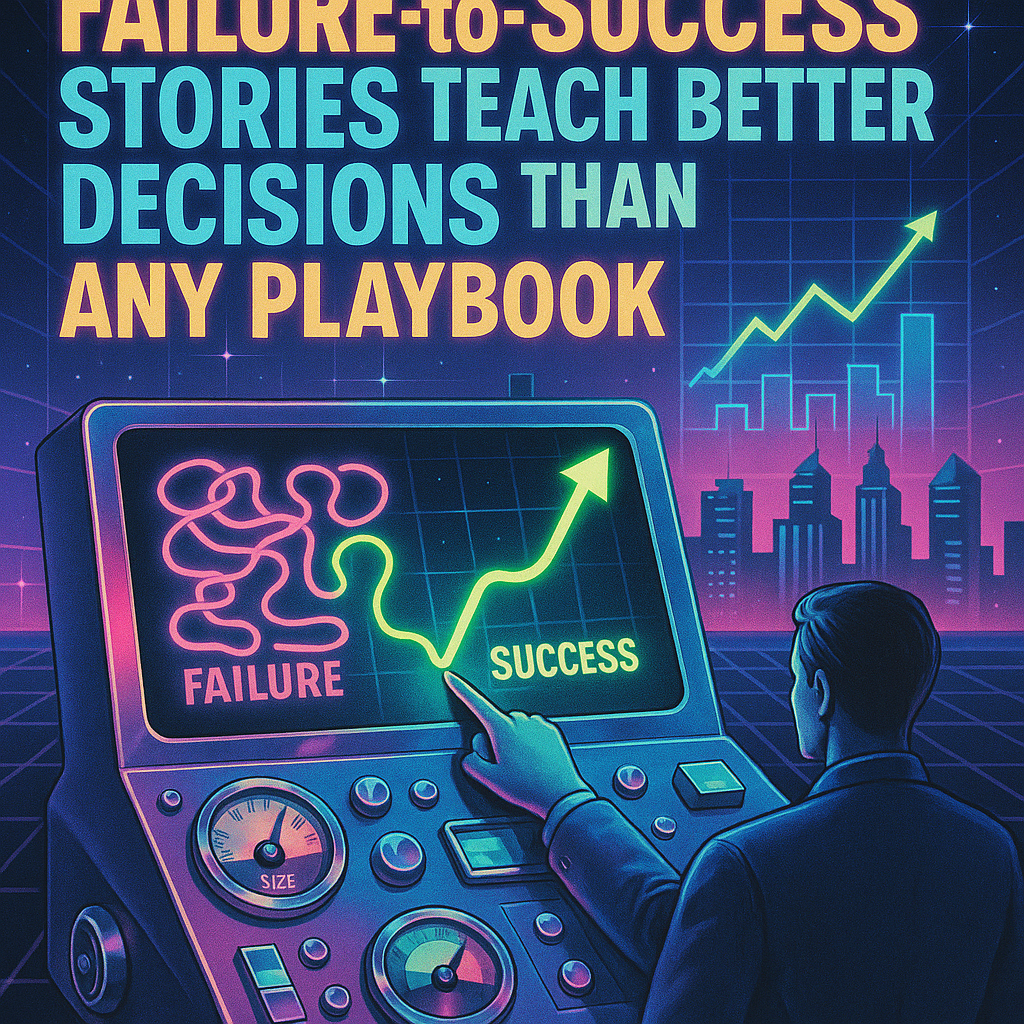
How Failure-to-Success Stories Teach Better Decisions Than Any Playbook
When the product tanked and the boardroom went silent, the founder did the thing most leaders fear: they mapped every assumption they had made and started again from the clearest losses. Failure-to-success stories often begin with an ugly truth. They also show a repeatable path: diagnose, remove vanity, test small, and protect morale.
That pattern matters because abstract advice rarely changes behavior. Reading case studies is useful. Watching someone dismantle their own strategy and rebuild is instructive. This article lays out the practical sequence you can apply the next time a launch, season, or quarter goes sideways.
Face the loss: diagnose what actually failed
Too many teams say "we failed" and move immediately to optimism. That wastes time. The first step in any failure-to-success story is precise diagnosis.
Start by separating outcomes from causes. A missed revenue number is an outcome. Poor product-market fit, flawed distribution, bad pricing, or execution gaps are causes. Treat each as an independent hypothesis to prove or disprove.
Use raw evidence. Customer interviews, funnel metrics, win/loss notes, and support tickets tell the truth. Don’t let explanations that flatter your ego pass as facts. Make sure the people closest to the work speak last in the diagnosis conversation; they often reveal root causes others miss.
Strip the ego, keep the signal: remove vanity from the plan
When a pivot works in failure-to-success stories it usually follows an act of ruthless subtraction.
Teams cling to features, marketing angles, or partner relationships because they represent past effort. That attachment clouds judgment. Create a neutral scoring rubric for ideas: impact, cost, time-to-learn. Then cut everything that scores low.
This is not permission to throw away identity. It is permission to stop investing in what demonstrably doesn’t move the needle. A cleaner product or roster or business plan helps everyone focus on the experiments that matter.
How to apply the subtraction test today
Write every active initiative on a whiteboard. For each, answer: what specific metric will change if this continues for 90 days? If you cannot answer with a metric and a time window, pause it.
Run fast experiments that answer one question at a time
The turnaround in most failure-to-success stories came from disciplined testing. They stopped big-bang fixes and ran tiny, fast experiments that answered single questions.
Design experiments to invalidate your favorite assumption. If you think pricing is the barrier, run a price test with a stripped-down offer. If you think onboarding loses users, rewrite the first two screens and measure completion.
Keep experiments cheap. A landing page, an email test, or a manual concierge service will teach more about customer behavior than another lengthy build. The goal is not to prove you were right. The goal is to learn fast and iterate.
Protect the team while changing the plan
The human factor shows up in every comeback story. People burn out when leaders treat reversal as punishment. Successful turnarounds reframe failure as data and maintain dignity.
Communicate the diagnosis, the experiments, and the criteria for success. Make progress visible and celebrate small wins. Protect the team from outside noise while you run learning cycles. That creates the psychological safety needed for rigorous iteration.
Sometimes the leader needs external frameworks to help re-anchor the group. Solid guidance on tone, decision-making, and accountability can make a fragile recovery durable. For those looking for models on rebuilding culture and decision discipline, ideas from experienced practitioners of leadership often prove useful to consider and adapt.
Scale what works, stop what doesn’t, and rebuild systems
A common endpoint of failure-to-success stories is not a single big victory. It is the replacement of brittle processes with reliable systems.
When an experiment succeeds, ask: what system change will lock in that result? That may mean automating a manual onboarding tweak, creating a new hiring rubric, or changing how you price offers. Conversely, remove processes that generated noise but no signal.
Measure the drift. Establish leading indicators that surface regressions early. Systems win because they make decisions repeatable and reduce dependence on any one person’s heroics.
Closing insight: make losing an input, not an identity
The most useful lesson from failure-to-success stories is philosophical and practical. Losing is a data input. It does not define your organization or your career. When you treat loss as information you change how you decide.
Diagnose precisely. Remove vanity initiatives. Run small experiments that answer specific questions. Protect the people doing the work. Turn wins into systems. Those steps convert costly drama into disciplined learning.
If you apply this sequence the next time something goes wrong you will have a playbook that actually works. You will not avoid failure. You will make failure teachable. That is the difference between repeating the same loss and building a comeback that lasts.
Leave a Reply