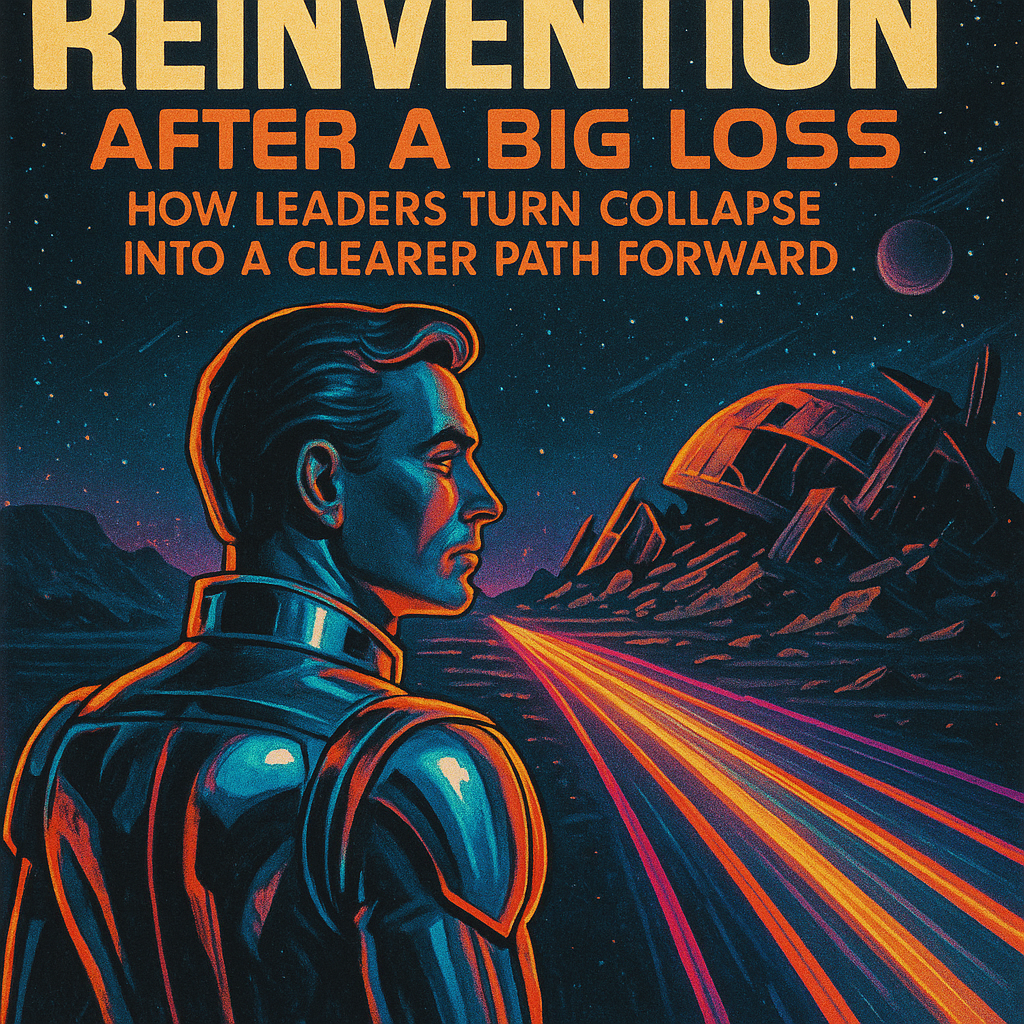
Reinvention After a Big Loss: How Leaders Turn Collapse Into a Clearer Path Forward
Three years ago a small business I advised lost its top three clients in six weeks. Revenue fell 60 percent. The founder watched a lifetime of work vanish in a single financial report. Reinvention became the only option.
Reinvention is the primary skill that separates businesses that recover from those that stall. It is not dramatic. It is steady, practical and disciplined. This article shows how to treat a collapse as raw data, not a verdict, and how to build a repeatable process that converts failure into forward motion.
Face the Failure Clearly: Diagnose, Don’t Deny
The first temptation after a big loss is story. You tell yourself comforting explanations to avoid pain. That costs time.
Start with plain diagnosis. What changed? Was it market demand, a concentration risk, a product mismatch or execution errors? Pull three facts you can verify and three hypotheses to test. Keep the facts on a single page.
Use simple metrics: revenue by client, margin by product, churn rate, and marketing cost per acquisition. If you lack data, treat conversations as data. Call former customers. Ask why they left. Capture verbatim objections. Those answers give you a map for what to test next.
Narrow the Problem and Design Small Experiments
Reinvention succeeds when leaders shrink the problem into testable pieces. If you try to redesign the entire business at once, you burn cash and morale.
Pick one core assumption to test each week. Is the assumption “customers value feature X” or “we can sell to a new segment”? Design a cheap experiment that will disprove that assumption if it is false.
A test might be a one-week ad run to a new audience, a manual sales outreach to a different industry, or a pilot product with three customers at a discounted price. Measure one clear result. If the test fails, you learned something. If it succeeds, scale slowly and repeat the experiment with a tighter target.
Quick experiment checklist
Keep experiments short and specific. Define the hypothesis, the minimum credible test, the success metric and the decision point. After each test, document what changed and why.
Rebuild Around Real Strengths: Keep the Core, Repackage the Rest
When a business collapses, the impulse is often to chase entirely new markets. That can work, but often the faster route is recombining what you already do well.
List five things your team does better than competitors. Those are your durable assets. They might be domain expertise, customer relationships, a lean cost structure, or unique data. Ask how those strengths solve adjacent problems for customers you already know.
Repackaging can be tactical. Change pricing models. Offer shorter contracts. Strip nonessential features to speed delivery. The goal is to create an offering people will buy now, not later.
Lead Through Truth and Small Wins
Your team will watch your behavior more than your words. When leaders hide failures or promise instant fixes, trust erodes.
Share the diagnosis and the first three experiments with the team. Invite critique. Assign ownership for learning, not just for execution.
Celebrate small wins publicly. Closed tests that produced clearer customer insights deserve the same attention as revenue wins. Those small victories rebuild confidence and create momentum.
If rebuilding culture matters, invest time in coaching and structure. For frameworks and thinking that help leaders reframe teams after setbacks, see the resource on leadership.
Commit to Learning Rhythms, Not One-Off Fixes
Reinvention is a practice, not a project. Schedule a weekly learning meeting where experiments are reviewed and decisions are made. Keep the meeting short and focused on what the next test should be.
Use a simple decision rule. For example, run three tests before you change strategy, or move a hypothesis from “uncertain” to “validated” only after it passes a threshold of repeatability.
Avoid the shiny-solution trap. Reinvention grounded in disciplined learning beats relentless pivoting. Each pivot should be a considered hypothesis, not panic.
Closing: How Loss Produces Clarity
Big losses feel like the end. They are not. They are a filter. Failure reveals which assumptions were fragile and which strengths remain.
The practical path forward is simple. Diagnose honestly. Test quickly. Rebuild around what you actually do well. Lead with transparency and embed learning into the rhythm of the organization.
When reinvention becomes a practiced skill, future losses stop being existential. They become sources of intelligence. That shift, more than luck or timing, turns losing big into the raw material for winning bigger.
Leave a Reply