Turning Failure into Success: How Losing Big Rewires Better Leaders
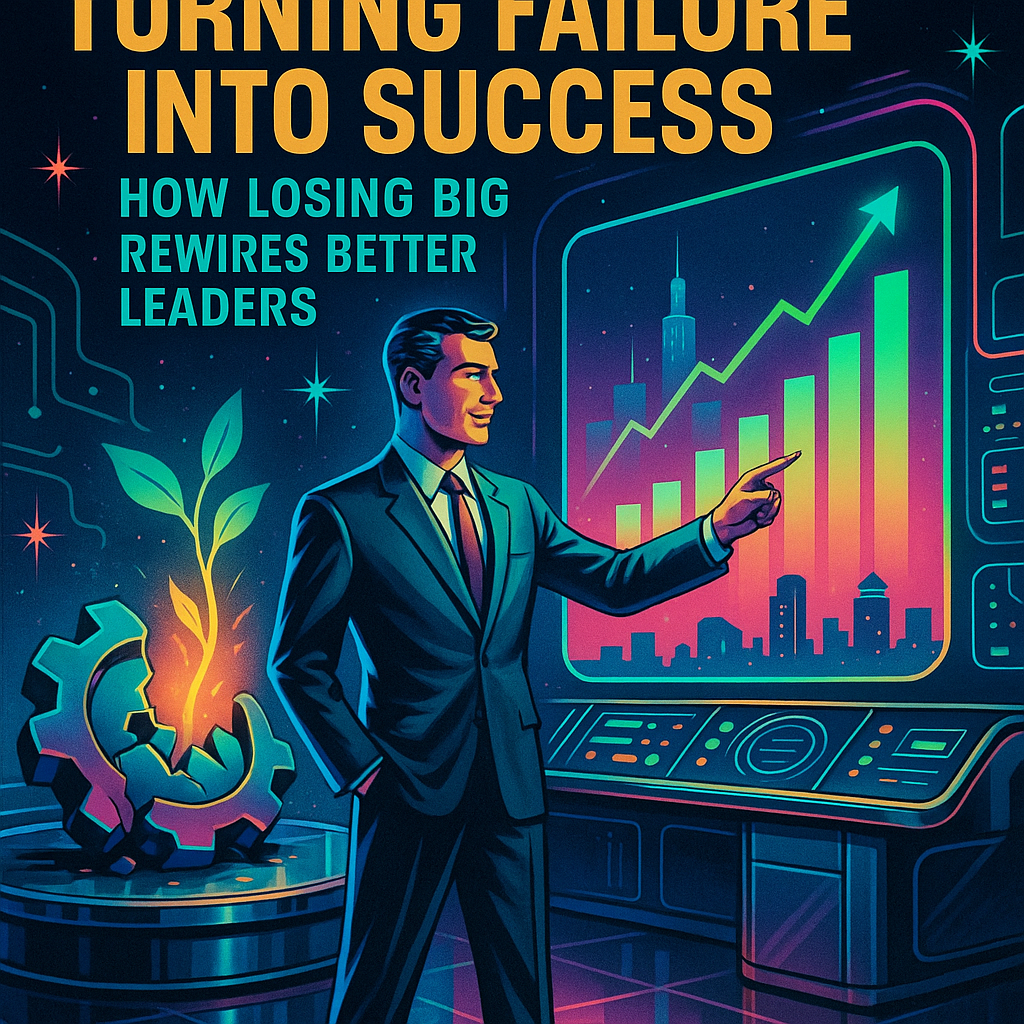
Turning Failure into Success: How Losing Big Rewires Better Leaders
Three years ago a small product team launched a feature they believed would double engagement. It tanked. Revenue dipped. Backers asked questions. The team could have folded or blamed timing. Instead they dissected every assumption, mapped the missed signals, and rebuilt a lighter version that outperformed the original.
That story captures the hard truth: turning failure into success is not a one-time emotional pivot. It is a structured habit. This article lays out practical moves you can use immediately to convert loss into durable gains.
Reframe the loss: treat failure as a data event
When a project fails, people look for villains. Leaders who learn from failure change the question. They ask: what did the outcome reveal about our assumptions, process, or incentives? This reframing turns shame into data.
Start by labeling outcomes objectively. Replace “we blew it” with “we observed X, Y, Z.” Keep the language clinical. That reduces defensiveness and makes analysis usable.
Capture three discrete data points from the failure: an assumption that proved false, a process breakdown, and an incentive mismatch. That simple triage guides immediate fixes and longer-term learning.
Extract micro-lessons and build repeatable experiments
Big failures hide small, testable lessons. Break the failure into micro-hypotheses you can validate quickly. For founders and operators this is the core mechanism for turning failure into success.
H3: How to write micro-hypotheses
Describe one change, the expected directional outcome, and the shortest test that could confirm or reject it. For example: “If we simplify the onboarding step from five fields to two, completion will rise 10% in two weeks.” Run the test, measure, and iterate.
H3: Make learning the deliverable
Treat learning as the primary output of early-stage work. Insist on a one-page learning memo after every failed sprint. Over time those memos become a knowledge base you can reuse and scale.
Remodel systems, not people
Many leaders respond to loss by replacing people. That rarely fixes systemic issues. Systems create behavior. Fix the system and the team follows.
Look for decision bottlenecks, unclear metrics, and misaligned rewards. Did a single gatekeeper slow iteration? Were success metrics gamed? Did incentives push the team toward short-term moves that undermined long-term value? Fixing these points prevents repeat failures.
Practical step: map the decision flow for the failed initiative. Identify three nodes where a wrong choice could have cascaded. Adjust governance at those nodes with clearer roles, time-boxed decisions, or escalation rules.
Convert personal setback into leadership muscle
Failure is a mirror for leaders. How you respond sets the tone. If you hide mistakes, the team hides them too. If you name mistakes, you create permission to surface problems early.
Model one visible behavior after each setback. Say, “Here’s what I missed,” in the next all-hands. Or publish the two-page postmortem and your short plan to correct course. That visible accountability trains the organization to treat failure as input, not identity.
This is also the place where formal learning resources help. Invest in coaching or peer review structures that normalize critique without blame. If you want others to step forward with hard truths, show them you can take them first.
Use tactical patience: when to iterate and when to fold
Not all failures deserve another try. A repeat attempt without new information is vanity. Leaders who master losing know when to iterate and when to quit.
Set a clear retry rule before you launch: a maximum number of iterations, a specific learning threshold, or a time limit. If your micro-hypotheses produce new, actionable data within those bounds, continue. If they don’t, reallocate resources fast.
That discipline prevents sunk-cost bias from turning a smart organization into a slow one. It also frees teams to pursue higher-expected-value work with less political friction.
Mid-article resource
If you want frameworks for how accountability and decision flows shape culture, many leadership frameworks map these connections cleanly. One practical place to read more about structuring responsibility and visible accountability is this resource on leadership.
Closing insight: losing is a capability you can cultivate
The organizations that win after losing do three things consistently. They turn emotion into evidence. They create short learning loops. They change systems rather than scapegoating people.
Those moves do not require heroics. They require discipline. Start small: make your next failure the basis for a one-page learning memo, run one micro-experiment, and publish one visible admission of error. Over time those simple habits compound. The next time something crashes, you will not just recover. You will rewire your team to win.
Failure becomes not a stain but a mechanism. Train it, document it, and use it. Your next loss will make you sharper, not smaller.